Our everyday experience of the world around us is provided primarily via the wave phenomena of light and sound. Collection of these signals can be enchanced technologically to improve our sensing ability, e.g., with telescopes and microscopes. More recently, sensing tools have been coupled to computers to give powerful new computed imaging modalities, e.g., X-ray computed tomography (CT), magnetic resonance imaging (MRI) and radio astronomy. Computed imaging requires an understanding of the signal measured (i.e., a physical model of the instrument is needed) and an ability to extract the desired information from the data using this model (i.e., the inverse problem must be solved). I work on computed imaging problems in optics, particularly in microscopy and spectroscopy. I am also interested in understanding the random nature of optical fields.
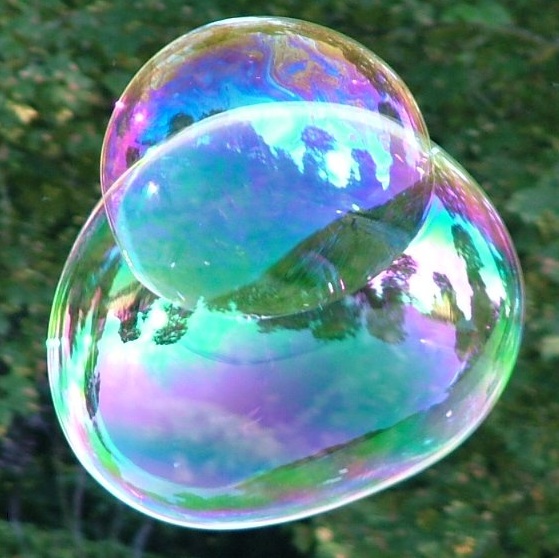
The photograph on the left illustrates some of the phenomena that I work with. Rainbow patterns on a soap bubble are produced by optical interference and its spectral (color) dependence (see this introductory tutorial for an explanation of the physics of soap bubble optics). We usually see these patterns only on thin structures, such as soap bubbles, as the random nature of light causes the interference patterns to wash out for thicker structures.
The projects below represent an (inexhaustive) list of my research interests and describe some of the specific applications. Links to some of my papers are provided where appropriate, but a complete list can be found via the "Publications" link above.
Spectral Self-Interference Microscopy
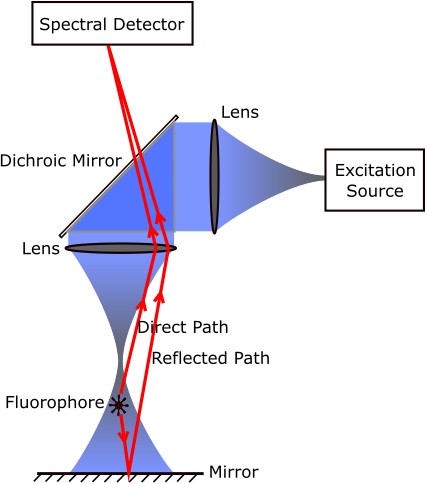
An illustration of SSM. Fluorescent emissions travel two paths to the spectroscopic detector, producing wave-length dependent interference.
Spectral self-interference microscopy (SSM) is a fluorescence imaging technique developed in my former group at Boston University. In SSM an object is stained with fluorescent molecules and placed above a mirror. The fluorophores are optically excited and emit light toward the observer and toward the mirror. The resulting effect is directly analogous to soap bubble interference. The light coming out of the sample displays spectral patterns which can be measured with a spectrometer. By analyzing these patterns we are able to infer the fluorophore-to-mirror distance with nanometer-scale precision.
Researchers are currently making great strides in the understanding of molecular and sub-cellular biological processes. Fluorescence microscopy is a very important tool in this effort, as fluorescent molecules can be attached to prescribed biological structures with great specificity and imaged in vivo. SSM has the potential to enable important new fluorescence studies, as it allows nanoscale depth localization of the fluorescent dyes. For example, SSM was demonstrated in the study of DNA confirmation in Moiseev et al., PNAS, 2006.
I was brought into the SSM project soon after the technique was conceived, and contributed to the first journal-published description of SSM. My doctoral work focused on providing a full mathematical description of the capabilities (and limitations) of SSM. This work also led to the recognition of a connection between SSM and 4Pi microscopy - a technique developed in the group of Dr. Stefan Hell - and resulted in a hybrid 4Pi-SSM instrument. A full description of the capabilites of SSM in noisy imaging environments has also been published and includes the use of an evanescent field to excite the fluorescent object.
Interferometric Synthetic Aperture Microscopy
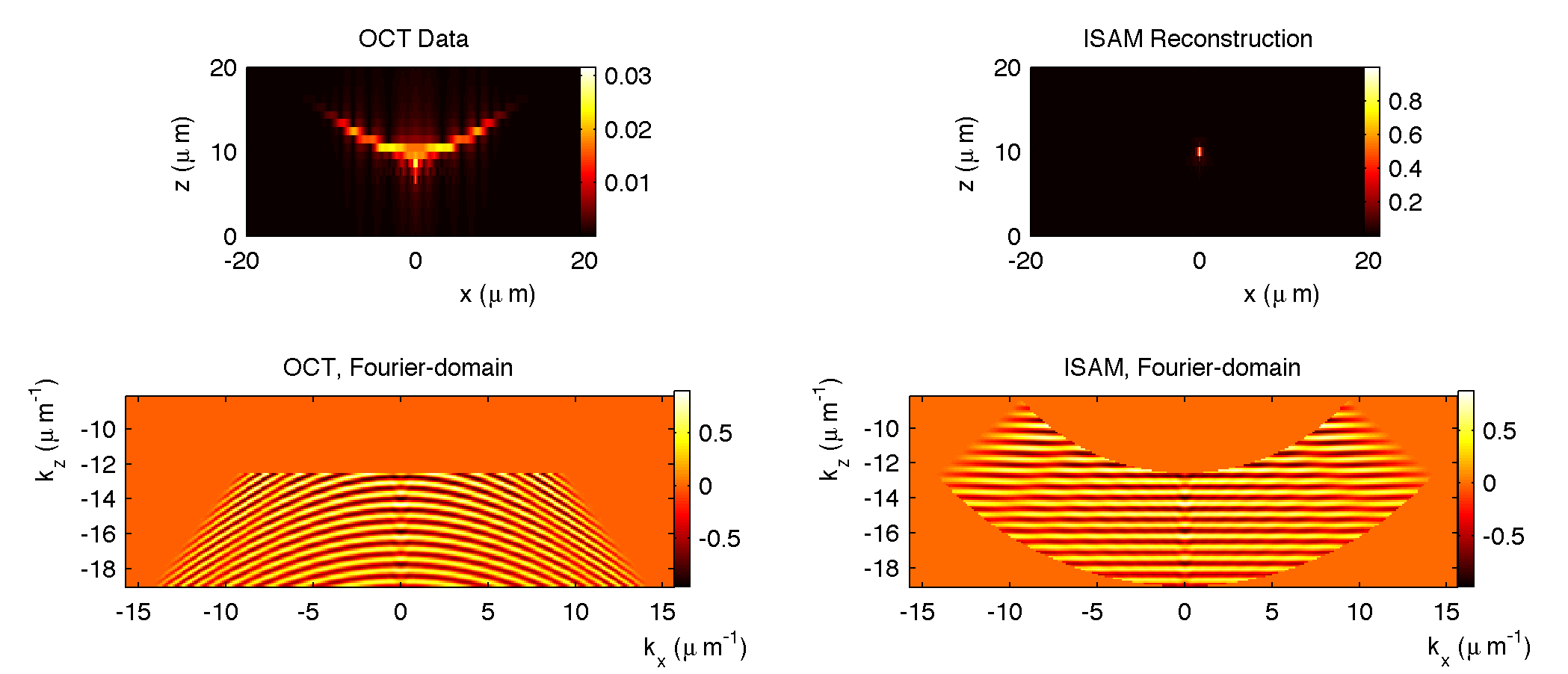
A simple version of ISAM can be implemented using only a warping in the Fourier space of the data. The OCT data shown on the upper left were calculated using the full electromagnetic, high-aperture response of an on-axis point scatterer in the out-of-focus region of the beam. On the lower left you can see the real part of the Fourier representation of these data. Applying the ISAM warping results in the lower right plot, where the phase fronts are now straight, as desirable for a point scatterer. The resulting spatial-domain profile is seen in the upper right. Notice the improved localization and the increased amplitude.
Interferometric Synthetic Aperture Microscopy (ISAM) is an optical imaging technique developed and demonstrated by Ralston, Marks, Carney, and Boppart. Rather than imaging a fluorescent sample, ISAM measures light scattered from an unstained object. ISAM is based on Optical Coherence Tomography (OCT), a maturing noninvasive technique that has already found application, particularly in opthamology. In addition, the Boppart group is actively pursuing the application of OCT and ISAM to other biomedical tasks, such as cancer detection in a variety of tissue types.
OCT and ISAM both rely on interferometric detection of scattered light. A broadband source is used and the resulting data are a function of two spatial variables and the wavelength - (x,y,λ). With the correct processing the data can be used to infer object structure in three spatial dimensions - (x,y,z). In OCT the image is reconstructed only where the probing light is in focus. The achievement of ISAM is to recognize that light outside of the focus can be computationally focused after data acquisition. This greatly improves the depth-of-field available. As in OCT, the processing used in ISAM requires interferometric detection of data, so that phase information is available. As the name of this technology indicates, ISAM has strong commonalities with Synthetic Aperture Radar (SAR). OCT can be viewed as analogous to standard radar.
I joined the ISAM research effort after the first physical demonstrations. My work includes a full electromagnetic high-aperture model for ISAM, which generalizes previous scalar results. The electromagnetic model clarified the mechanisms behind ISAM - in particular it was shown that the stationary-phase approximation should be used to derive the ISAM processing algorithm for scatterers that lie out of focus. Despite the nonparaxial and vectorial nature of the model, it was shown that the main action of the ISAM processing can be reduced to a simple Fourier-domain data warping. In addition, I was involved in demonstrating that ISAM implicitly mitigates the autocorrelation artifact produced by frequency-domain data collection.
Coherence Theory and Ultrafast Pulse Measurement
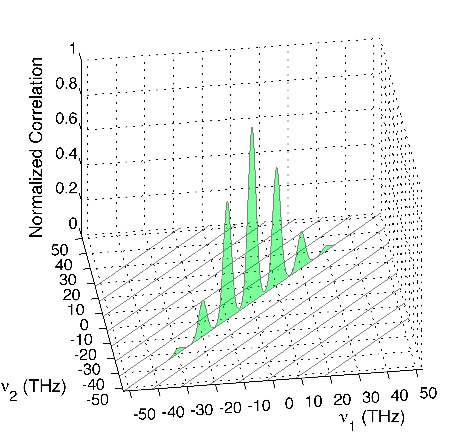
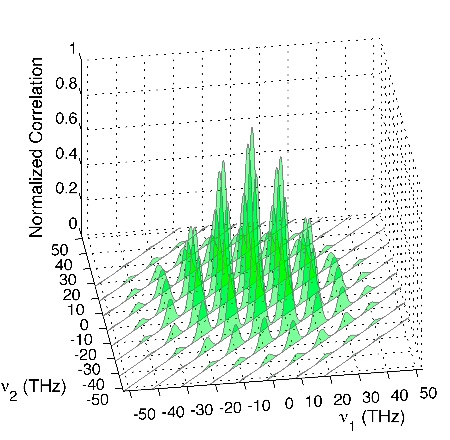
The two-frequency spectra of stationary (left) and pulsed nonstationary (right) fields. The two fields have the same spectral distribution of energy since the spectra are identical on the ν1=ν2 locus. The stationary field exhibits no frequency-to-frequency correlations while the pulsed (nonstationary) field does. These correlations are known as modelocking in pulsed lasers - the modes need to be correlated to produce a pulsed optical field.
Optical fields are subject to random fluctuations and can therefore be considered statistically. The study of optical-field statistics is usually known as "coherence theory." Many optical fields are statistically stationary which means that the statistics do not vary with time. The assumption of stationarity allows the invocation of the celebrated Weiner-Khintchine theorem. This theorem states that each frequency component (i.e. each color or wavelength) is statistically independent of all other frequency components. This useful result means that an optical field can be analyzed frequency-by-frequency and the results incoherently summed to get the total field. Many stationary fields are also ergodic, which means that the field statistics can be estimated from physical measurements.
The use of pulsed lasers is becoming more prevalent in modern optical applications. Fields from pulsed lasers have a repeating temporal structure and are therefore nonstationary. This introduces correlations in the spectrum (as shown in the diagram above) and necessitates the use of a more general coherence theory. In addition, ergodicity is no longer applicable and care needs to be taken with the interpretation of optical measurements.
I have applied the theory of cyclostationary random processes to optical fields. A cyclostationary field has statistics that repeat periodically - a model applicable to pulsed lasers. Cyclostationarity and cycloergodicity allow the construction of a coherence theory for pulsed fields that can be used to guide the interpretation of physical measurements. I have shown how standard ultrafast pulse measurement instruments can be used in a many-pulse regime (generally, the standard use is to measure only a single pulse) and the resulting data used to infer nonstationary statistics of the field. This indicates a direction toward the comprehensive characterization of pulsed laser stability. In addition to contributing to nonstationary coherence theory, I have also developed numerical space-time simulators for stationary fields and described a computationally efficient numerical alternative to the standard coherent mode decomposition.
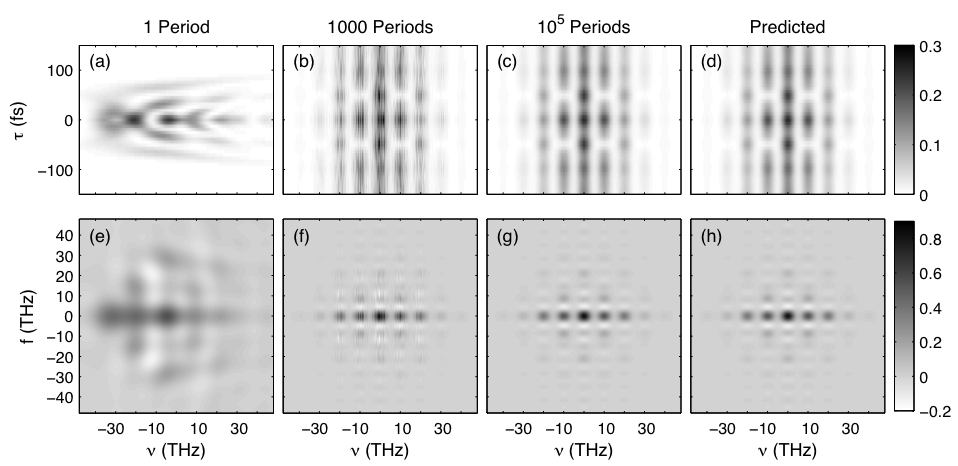
This figure shows simulated data for a stationary field measured by a frequency resolved optical gating (FROG) system. The top row shows data as a function of delay and frequency, while the bottom row shows data as a function of delay-frequency (the Fourier variable corresponding to delay) and frequency. The data for a single temporal period are significantly different from those given when the instrument is allowed to collect many periods. It can be seen that the data converge to those predicted by my theory.
Synthetic Aperture Sonar
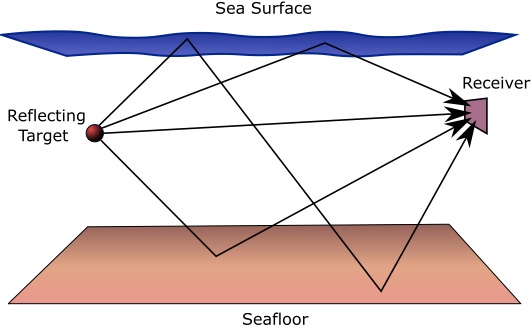
Illustration of multipath propagation in a sonar system.
Like ISAM, synthetic aperture sonar (SAS) and synthetic aperture radar are coherent imaging techniques that use image reconstruction to synthesize an image. As part of the masters program at the University of Arizona I performed research into the effects of multipath propagation in SAS imaging. My work showed that the SAS processing localizes the desirable line-of-sight signal but leaves the multipath artifacts blurred.